For years, Airport Digital Accessibility has been overlooked in favor of physical accessibility measures such as elevators, adapted restrooms, meeting points for passengers with reduced mobility (PRM), and assistance staff. These are necessary investments and, at many airports, they are already well addressed.
But there is one question that physical infrastructure cannot answer: can a passenger with a disability find their way independently?
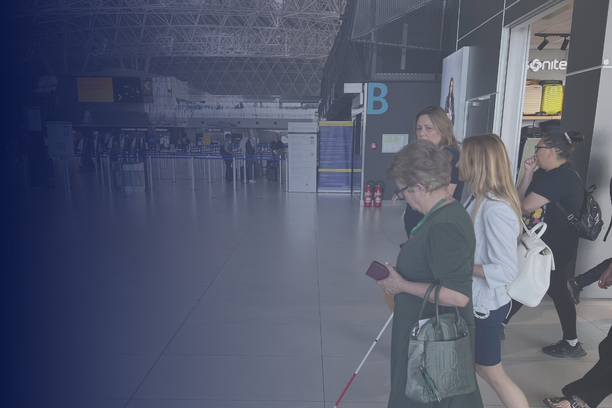
For millions of travelers with visual, hearing, cognitive, or mobility disabilities, the answer is still no. Understanding the layout of a terminal, locating the right elevator, or reaching the boarding gate without relying on others continues to be a source of stress and uncertainty.
This is where Airport Digital Accessibility becomes essential. The challenge is no longer just providing accessible infrastructure, but also giving passengers the digital tools they need to navigate the airport independently.
A Problem with a Name: SSR Codes
The aviation industry already identifies passengers with specific needs through IATA SSR (Special Service Request) codes. Each category represents a different navigation need:
- BLND – Passengers with visual impairments
- DPNA – Passengers with cognitive or intellectual disabilities
- DEAF – Passengers with hearing impairments
- WCHR, WCHS, WCHC, WCBD, WCBW, WCMP – Passengers with reduced mobility and wheelchair users
- SVAN, ESAN – Service animal users
Each of these profiles requires a different response. A step-free route does not address the needs of a person with a visual impairment; voice guidance does not solve the needs of a wheelchair user. True accessibility requires complementary technologies, rather than a one-size-fits-all solution.cesibilidad real exige tecnologías complementarias, no una solución única para todos.
Two Technologies, One Complete Experience
This is precisely the approach that ViaDirect and Ezymob have jointly developed for Franjo Tuđman Airport in Zagreb.
ViaDirect Mobile provides accessible navigation through:
- Step-free routes
- Elevator prioritization
- Accessible route calculation
- Mobile wayfinding without the need to download an app
Ezymob adds a personalized guidance layer:
- Audio navigation
- Vibration feedback
- Cognitive assistance with simplified instructions
- High-precision indoor positioning
Together, they cover virtually the full spectrum of needs: visual and cognitive disabilities through Ezymob; reduced mobility, wheelchair users, service animals, and hearing impairments through ViaDirect Mobile. The only needs outside the scope are medical or oxygen-related assistance (MEDA, PPOC, POXY, AOXY, OXYG, STCR), which by their nature require direct human intervention.
From Arrival to Boarding, in Five Steps
The experience designed for Zagreb reduces accessible navigation to a simple, independent journey:
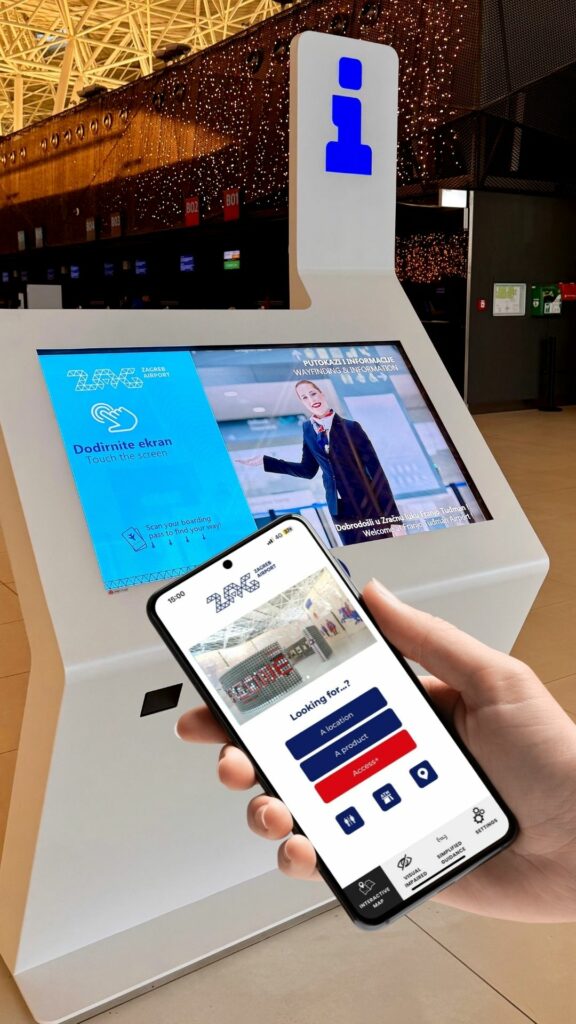
- Scan a QR code at an information point or kiosk
- Open accessible navigation directly on your mobile device, with no download required
- Select your destination: boarding gate, accessible restroom, store, assistance point
- Follow the accessible route, calculated to avoid stairs and prioritize elevators
- Reach your destination independently
No step requires intervention from airport staff, although human assistance remains available when needed. This distinction is precisely what defines the approach: the goal is not to replace human assistance, but to provide a layer of digital guidance that reduces dependence and gives passengers greater autonomy.
Why This Matters for Airports
Beyond its impact on the passenger experience, accessible navigation has direct implications for airport operators:
- Regulatory compliance: digital accessibility complements the physical accessibility requirements already established under European air transport regulations.
- Reduced pressure on assistance staff, by digitally resolving the most frequent wayfinding questions.
- Competitive differentiation: few airports currently offer a truly inclusive navigation experience, making digital accessibility a powerful brand and passenger experience differentiator.
- Usage data: every interaction with accessible navigation generates insights into the terminal’s real friction points, going beyond what physical accessibility audits can reveal.
An Experience, Not Just a Route
The Zagreb case illustrates an important shift in perspective: accessibility can no longer be considered solely in terms of built infrastructure. An airport may have all the necessary elevators and adapted restrooms and still be a place where a passenger with a disability feels lost or dependent.
Accessible wayfinding brings accessibility from the physical environment into the realm of the passenger experience. And ultimately, that is the true measure of an inclusive airport: not simply that the path exists, but that every passenger can find it independently.
Want to Bring Accessible Navigation to Your Airport?
ViaDirect and Ezymob have already demonstrated in Zagreb that digital accessibility and passenger autonomy can coexist with existing physical infrastructure, without requiring users to download an app.