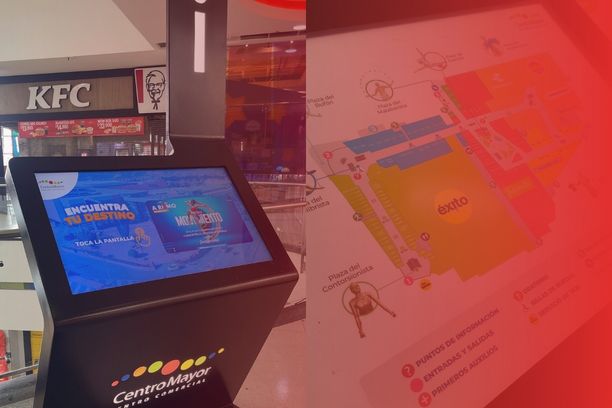

A practical guide to improving passenger flow, reducing stress, and enhancing the airport experience with digital wayfinding
Airports are among the most complex public environments. With millions of passengers moving through terminals, gates, security checkpoints, and services every day, clear navigation is critical.
When passengers get lost or confused, the impact is immediate: missed flights, long queues, stressed travelers, and staff constantly interrupted to give directions.
Interactive wayfinding kiosks provide a scalable and effective solution. But successful implementation requires more than installing screens. It requires a strategic, connected approach.
Why airports need interactive wayfinding kiosks
Passenger expectations have evolved. Travelers expect the same level of clarity and real-time information they experience in digital environments.
Traditional signage alone is no longer sufficient in:
- Large multi-terminal airports
- Continuously evolving layouts
- High international traffic with language barriers
Interactive kiosks solve this by providing:
- Instant access to directions
- Multilingual search
- Real-time updates
- Personalized routing

They reduce confusion while improving operational efficiency across the airport.
Step 1: Identify key passenger touchpoints
Effective kiosk deployment starts with understanding where passengers need help the most.
The most strategic locations typically include terminal entrances, check-in areas, security exits, retail zones, and gate intersections. These are key decision points where passengers are most likely to hesitate or change direction.
Step 2: Design an intuitive user experience
A kiosk must be usable instantly, without instructions.
Passengers should be able to search, understand, and access their route in seconds. This requires a clear interface, simple navigation, readable typography, and strong accessibility features such as multilingual support and adapted routes.
Step 3: Integrate web-based navigation before arrival
Wayfinding should begin before passengers enter the airport.
By embedding an interactive 3D map into the airport website via an iframe, airports allow travelers to explore terminals, locate services, and plan their journey in advance.
This reduces uncertainty, improves punctuality, and creates a smoother experience from the very beginning.
Step 4: Connect kiosks to a real-time mapping system
Static maps quickly become outdated in airport environments.
Kiosks must be connected to a centralized platform that updates in real time, reflects operational changes, and ensures consistency across all touchpoints.
This guarantees that passengers always receive accurate and reliable directions.
Step 5: Extend the experience to mobile (QR, no app)
Kiosks should initiate a journey, not limit it.
With a simple QR code scan, passengers can transfer their route to their smartphone and continue navigation without downloading an app.
This ensures continuity, reduces friction, and provides real-time, step-by-step guidance across large airport spaces.
- Step 6: Use data to optimize passenger flow
- Digital wayfinding generates valuable insights into how passengers move through the airport.
- This data helps identify congestion points, optimize layouts, and improve overall flow without requiring additional infrastructure.
Step 7: Ensure scalability and adaptability
Airports are constantly evolving.
A successful wayfinding system must scale across terminals, adapt to changes, and integrate with existing systems to ensure long-term performance.
From wayfinding to passenger experience
Interactive kiosks are not just tools. They are part of a broader navigation ecosystem that connects web, on-site, and mobile experiences.
When combined, they reduce stress, improve efficiency, and create a more seamless passenger journey.
It is about improving how passengers move, experience, and interact with the airport.
By combining kiosks, mobile navigation, and web-based maps, airports can deliver a more intuitive, efficient, and scalable experience.
Looking to improve passenger flow in your airport? Talk to our team to discover how ViaDirect can help you design a seamless wayfinding experience across your terminals.