
Navigating an unfamiliar terminal is a challenge for anyone. For a person with a visual impairment, it is one of the situations where having to rely on others can be particularly difficult. ViaDirect Mobile’s voice guidance feature provides step-by-step assistance, guiding users from their current location to their destination without requiring them to install an app.
Independence via a QR Code
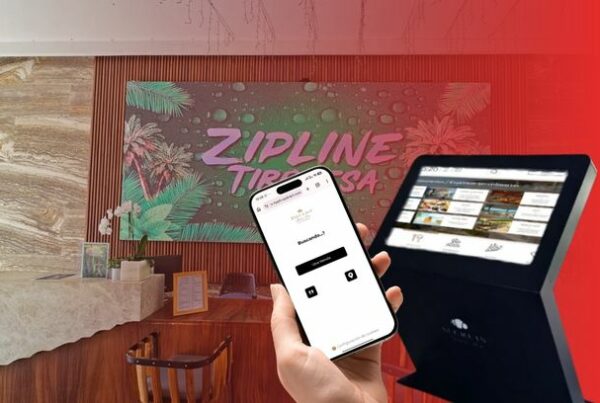
Voice guidance works on the ViaDirect map already used by the venue. Visitors scan a QR code at the entrance, a web page opens on their phone, and the journey begins. There are no downloads and no accounts to create.
This has an important practical benefit for operators: the same locations, routes, and map updates already in use can also be used for voice guidance.
How It Works: Four Gestures, One Guiding Voice
1. Choose the starting point and destination. The interface uses large buttons, high contrast, and allows users to search or browse through a list of categories. Each selection is confirmed aloud.
2. Start from the right location. When a starting point exists in several locations, the phone’s GPS suggests the closest one.
3. Follow the directions. Each screen displays a large pictogram, a clear instruction, and a single button: Next. Changes of floor are clearly announced.
4. Stay on the right path. The phone’s compass indicates which direction to take, the step counter advances the guidance, and the application alerts the user as soon as they take the wrong path.
The journey was tested in real-world conditions at Verona Airport, where the online demonstration can also be experienced directly from a smartphone.
Designed to Be Accessible, and Audited to Prove It
The accessibility of an accessibility tool should not be taken for granted. That is why the voice guidance solution underwent an independent audit based on RGAA 4.1.2 and WCAG 2.1 and 2.2 (Levels A and AA). The audit combined the NVDA screen reader with a complete keyboard-only journey.
The results:
- 100% of the assessed RGAA criteria compliant (47 out of 47).
- 0 non-conformities detected, under either RGAA or WCAG.
- 34 WCAG A and AA criteria compliant.
- 12 screens audited, covering the entire application.
The full audit report is available in English and French.
Compatible with the Tools People Already Use
The voice guidance works with VoiceOver and TalkBack. The application’s voice can also be turned off, allowing users to rely on their own screen reader, which they are already familiar with. The service is available in Spanish, French, and English, with a natural voice for each language.
Routes also take elevators into account for people with reduced mobility, while the large touch areas make the interface easier to use for people with visual impairments.
Why It Matters to Airport Operators
Free physical assistance for travelers who need it is a regulatory requirement, for example under European Regulation 1107/2006, the Air Carrier Access Act in the United States, and ICAO recommendations. It is a service that does not generate revenue, while demand is increasing as passenger populations age, creating additional operational pressure and staffing costs.
As a reference, one airport has reported a cost of between USD 23 and 40 per assistance intervention carried out by staff, including salaries, training, and logistics. When travelers with visual impairments who are able to do so can navigate independently, there are fewer requests for assistance and staff remain available for those who need them most.
A Regulatory Framework That Is Becoming More Stringent
Digital accessibility is no longer optional:
- Europe: Since June 2025, the European Accessibility Act has made digital accessibility mandatory for many services, including passenger transport services.
- United States: The ADA requires places and services open to the public to be accessible.
- Standards: WCAG and RGAA are the technical standards used to demonstrate compliance.
Providing independent guidance for people with visual impairments helps meet regulatory requirements, but above all, it sends a clear message to all visitors that the space has been designed with them in mind.
Try It on the Verona Airport Map
Experience the demonstration from your smartphone and discover what a complete voice-guided journey sounds and feels like. If you would like to see how it could work on your own map, our team can show you the voice guidance solution and answer your questions.
ViaDirect has been dedicated to wayfinding for 17 years, with more than 400 projects across 35 countries. Voice guidance is now part of a platform already proven in airports, shopping centers, hospitals, and campuses.